Genetic Resemblance Estimator
How Your Baby Will Resemble Parents
Select your IVF scenario to see which traits your child will inherit from which parents.
Your Baby's Resemblance
Genetic Resemblance Pattern
Many people wonder if babies born through IVF (In Vitro Fertilization) look more like their mom or dad. It's a question that pops up often, especially among couples considering fertility treatments. But the answer isn't as simple as it seems. The truth is, IVF itself doesn't change how a baby looks. The process is simply a method to help conception. Once the embryo forms, the baby's physical traits are determined by the same genetic rules that apply to naturally conceived children.
How IVF Works: A Quick Overview
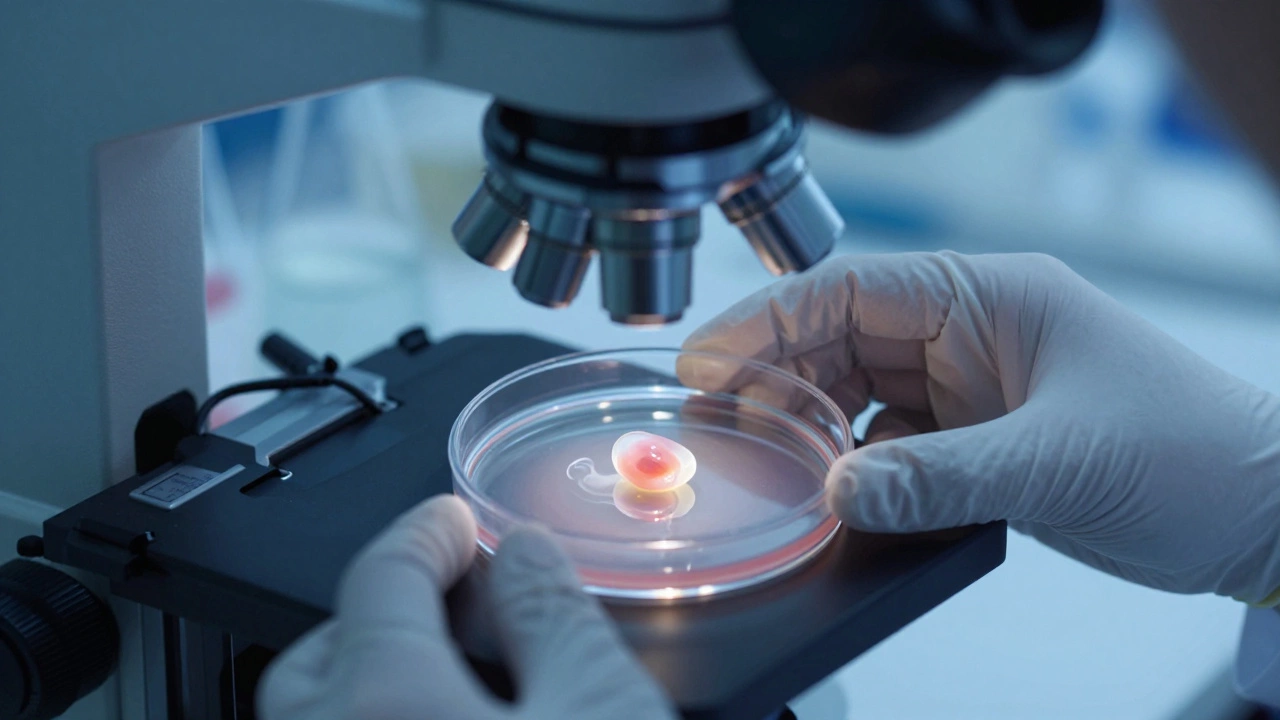
IVF stands for In Vitro Fertilization. It's a medical procedure where an egg and sperm are combined in a laboratory dish. After fertilization, the resulting embryo is transferred to the uterus. The key point here is that IVF is just a way to help conception happen-it doesn't alter the genetic makeup of the baby. Whether the baby is conceived naturally or through IVF, their physical traits come from the DNA of the biological parents.
Genetics: The Real Story Behind How Babies Look
When you think about why we look like our parents, it's all about genetics. Every child inherits half their genes from their mother and half from their father. These genes determine everything from eye color to facial structure. In IVF, the same genetic rules apply. If both parents provide their own eggs and sperm, the baby will share traits from both. For example, a child might inherit their mother's eye color and their father's nose shape. It's a natural mix, just like in any other pregnancy.
Some people worry that the lab environment of IVF might affect how genes express themselves. But research shows this isn't the case. A 2023 study published in the Journal of Assisted Reproduction and Genetics found no significant differences in physical appearance between IVF-conceived children and those conceived naturally when both used parental gametes. The process of combining eggs and sperm in a lab doesn't change the genetic code.
When Donors Are Involved: What Happens to Resemblance?
Things get more complex when donors step in. If a couple uses a donor egg, the child's genetic mother is the donor. So the baby will resemble the egg donor and the father. Similarly, if a sperm donor is used, the child will resemble the mother and the sperm donor. Let's break this down with a clear example.
| Scenario | Child's Resemblance |
|---|---|
| Both parents' own eggs and sperm | Mix of traits from both biological parents |
| Donor egg + father's sperm | Resembles donor and father; not the intended mother |
| Donor sperm + mother's egg | Resembles mother and sperm donor; not the intended father |
| Surrogacy with donor egg and sperm | Resembles both donors; neither intended parent |
For instance, if a woman uses a donor egg and her partner's sperm, the baby will inherit traits from the egg donor and the father. The intended mother won't share genetic links with the child, so the baby won't resemble her. Similarly, if a man uses donor sperm with his partner's egg, the child will look like the mother and the sperm donor, not him.
Surrogacy and Resemblance: Clarifying the Myths
Surrogacy often gets mixed up with IVF. In gestational surrogacy, the surrogate carries the baby but doesn't provide the egg. So the child's genetics come from the intended parents or donors. This means the surrogate won't share any biological traits with the baby. For example, if a couple uses their own eggs and sperm with a surrogate, the baby will look like both parents-not the surrogate. The surrogate's role is purely to carry the pregnancy, not to contribute genetically.
Some people mistakenly think that surrogates influence the baby's appearance. But this isn't true. The baby's physical traits are determined solely by the DNA of the biological parents or donors. Surrogacy simply provides a womb for the pregnancy to develop.

Debunking Common Myths About IVF Babies
There are several myths floating around about IVF babies. One common myth is that IVF babies look different from other children. This isn't true. IVF doesn't alter the genetic process. The baby's appearance is entirely based on the DNA from the biological parents. Another myth is that IVF babies are more likely to have birth defects or unusual features. Studies from the New England Journal of Medicine show no increased risk of birth defects in IVF babies compared to naturally conceived children.
Another myth is that the lab environment affects the baby's genes. But IVF labs follow strict protocols to mimic natural conditions. The petri dish isn't some magical place that changes DNA-it's just a controlled environment for fertilization. Once the embryo is formed, it develops exactly like it would in the body.
Expert Insights on IVF and Genetic Resemblance
Dr. Priya Sharma, a fertility specialist at Apollo Hospitals in Bangalore, explains: "From a genetic perspective, IVF doesn't alter inheritance patterns. The baby's appearance is solely determined by the DNA contributed by the biological parents. Whether it's through IVF or natural conception, the child's features come from the same genetic pool. We often get asked this question, and the answer is straightforward-IVF babies look like their parents when the parents' own gametes are used." She adds, "When donors are involved, it's important for parents to understand which parent the child will resemble. Open communication with the fertility team helps set realistic expectations about genetic traits."
Do IVF babies look different from other children?
No, IVF babies do not look different from children conceived naturally. Their physical traits are determined by the same genetic rules. The IVF process itself doesn't change how genes are inherited or expressed. Studies consistently show no differences in appearance between IVF and naturally conceived children when the same biological parents are involved.
If I use a donor egg, will my child look like me?
If you're the intended mother using a donor egg, your child won't share your genetic traits. The baby will resemble the egg donor and the father (if his sperm is used). If you're the intended father, the child may resemble you since you contributed sperm. It's important to discuss these possibilities with your fertility specialist before starting treatment.
Can IVF babies resemble the surrogate mother?
No, IVF babies do not resemble the surrogate mother in gestational surrogacy. In this process, the surrogate carries the baby but doesn't provide the egg. The baby's genetics come entirely from the intended parents or donors. The surrogate's role is purely to support the pregnancy; she has no genetic connection to the child.
Do IVF babies have a higher chance of birth defects?
Research shows no significant increase in birth defects for IVF babies compared to naturally conceived children. A large study by the New England Journal of Medicine found that IVF procedures don't raise the risk of congenital anomalies when controlling for factors like maternal age. The IVF process is safe and follows strict medical standards.
How do I know which traits my IVF baby will inherit?
In most cases, the traits your child inherits depend on the biological parents' genes. If you're using your own eggs and sperm, you can expect a mix of features from both. If donors are involved, the child will resemble the donor and the other parent. Genetic counseling can help you understand possible trait combinations before starting IVF treatment.